
2025 coordination tools need reevaluation
What developers know that the rest of us are learning
Dec 10, 2025



The tools we use to coordinate work are due for reevaluation.
The 2025 Stack Overflow Developer Survey with over 30,000 responses just confirmed what many of us suspected: the legacy coordination tools are losing their grip.
Developers have always been the canary in the coal mine for software. They abandon what does not work and adopt what does. When developer sentiment shifts, the rest of the market follows within a few years.
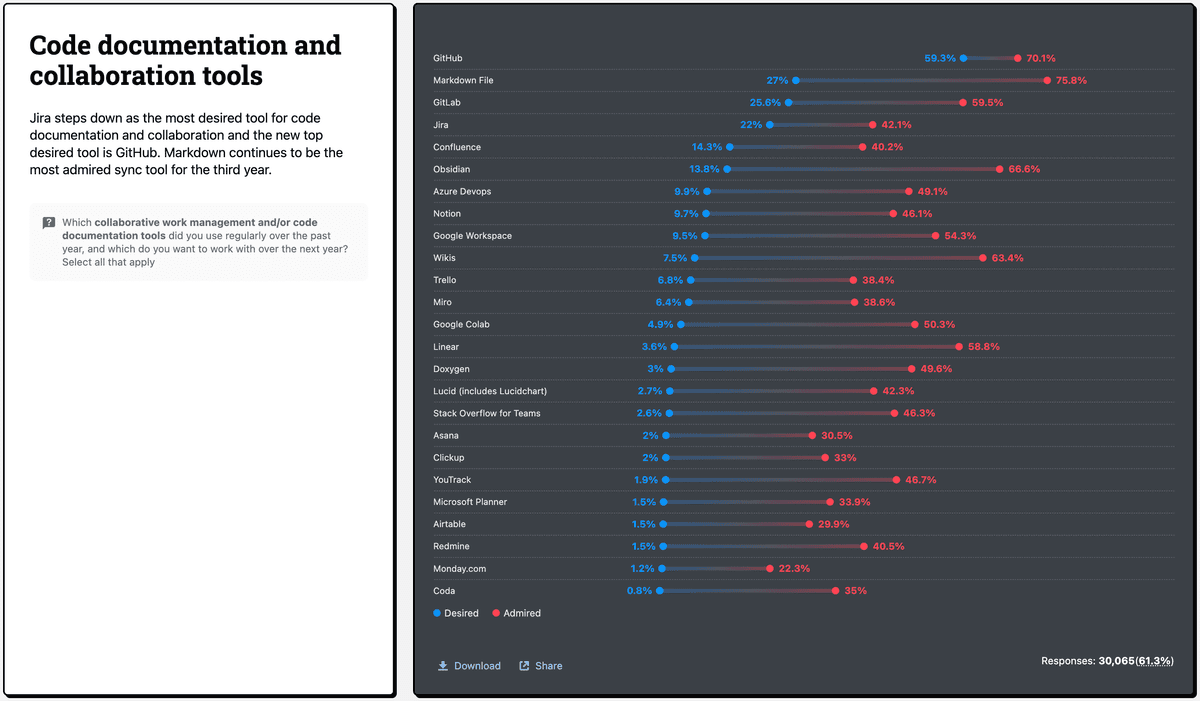
Jira stepped down as the most desired collaboration tool this year. After years of dominance, the tide has turned. Markdown, plain text files, remains the most admired sync tool for the third year running. Developers are choosing simplicity over features. They would rather coordinate through text files than through complex platforms.
The gap between have to use and want to use tells the story. Jira has 22% usage but only 42% want to continue using it. More than half of current users would leave if they could. Confluence sits at 14% usage with 40% admiration. These tools became the coordination tax they were supposed to eliminate.
The rising tools tell the opposite story. Linear: 3.6% usage, 59% admiration. Obsidian: 14% usage, 67% admiration. Small, fast, focused products that solve one problem well. What do these tools have in common? They do less. They have opinions. They get out of the way. They treat coordination as overhead to minimize, not capability to maximize.
Notion has lost the plot. They want to be the blank canvas. That is their goal. It appeals to creative people who want to build their perfect system. But what they find is it is never good enough. It never solves the problem. And they end up using a hundred different tools anyway. Opinions are a good thing. With an opinion, you get coordination with other companies who use the same system. You can train people faster because there is documentation. Everybody knows what they are doing because it is already decided and proven to work.
Developers are leading this shift but it will not stay in engineering. The same bloat that frustrates dev teams frustrates every team trying to get work out the door. Marketing teams. Ops teams. Agencies. Anyone who has ever thought we spend more time updating our tools than doing the work.
The next wave of coordination software will not win by adding features. It will win by removing overhead. By making the handoff invisible. By treating coordination as a cost to minimize, not a feature to sell. We are building that tool. It is called Snapwork.
Written by a robot, refined by a human.